A SurveyMonkey alternative for feedback you have to answer
SurveyMonkey is a research tool: it tells you what a population thinks. Formisse is an inbox: it tells you what each person wants, and which one cannot wait.
First, an honest filter
If you are running research (sample sizes, statistical significance, cross-tabs, market panels), stay with SurveyMonkey.
We do not do any of that, and building it is not on our roadmap. Closing this tab is the right outcome, and we would rather say so on the first screen than waste your afternoon.
This page is for the other kind of SurveyMonkey user: the one whose survey is really a feedback form, a support enquiry form or a request form, where every response is one person expecting something back.
The one-line difference
SurveyMonkey analyses a population.
Formisse analyses a person.
SurveyMonkey's AI text analysis groups your open-ended answers into themes: 40% of respondents mentioned delivery times, sentiment on pricing skewed negative. That is exactly the right output when you are deciding what to change about a product.
It is the wrong output when someone has just written "I have been charged twice and nobody has replied to my last two emails." That response does not need to become a theme. It needs someone to see it today.
Formisse reads each submission as it lands and puts the answer in the list: what this person is asking for, what category it falls into, how urgent it is and what to do next. No batch, no analysis run, no waiting for enough responses to make a theme.
What SurveyMonkey does well
It has been the default survey platform for two decades and deserves it.
-
Research-grade analysis
Cross-tabs, statistical significance testing and multi-survey comparison.
-
AI text analysis
Groups open-ended answers into themes with sentiment.
-
A global respondent panel
You can buy an audience rather than find one.
-
Hundreds of expert-built templates
For NPS, CSAT, engagement and market research.
-
Enterprise controls
Single sign-on, compliance features and deep integrations.
If your question is "what do people in general think", SurveyMonkey answers it and Formisse does not.
Where Formisse is different
-
Per response, not per theme
Formisse's output is about one submission: this person, this request, this urgency. SurveyMonkey's is about the set: these themes, this sentiment distribution. Neither is better; they answer different questions. Pick the one that matches yours.
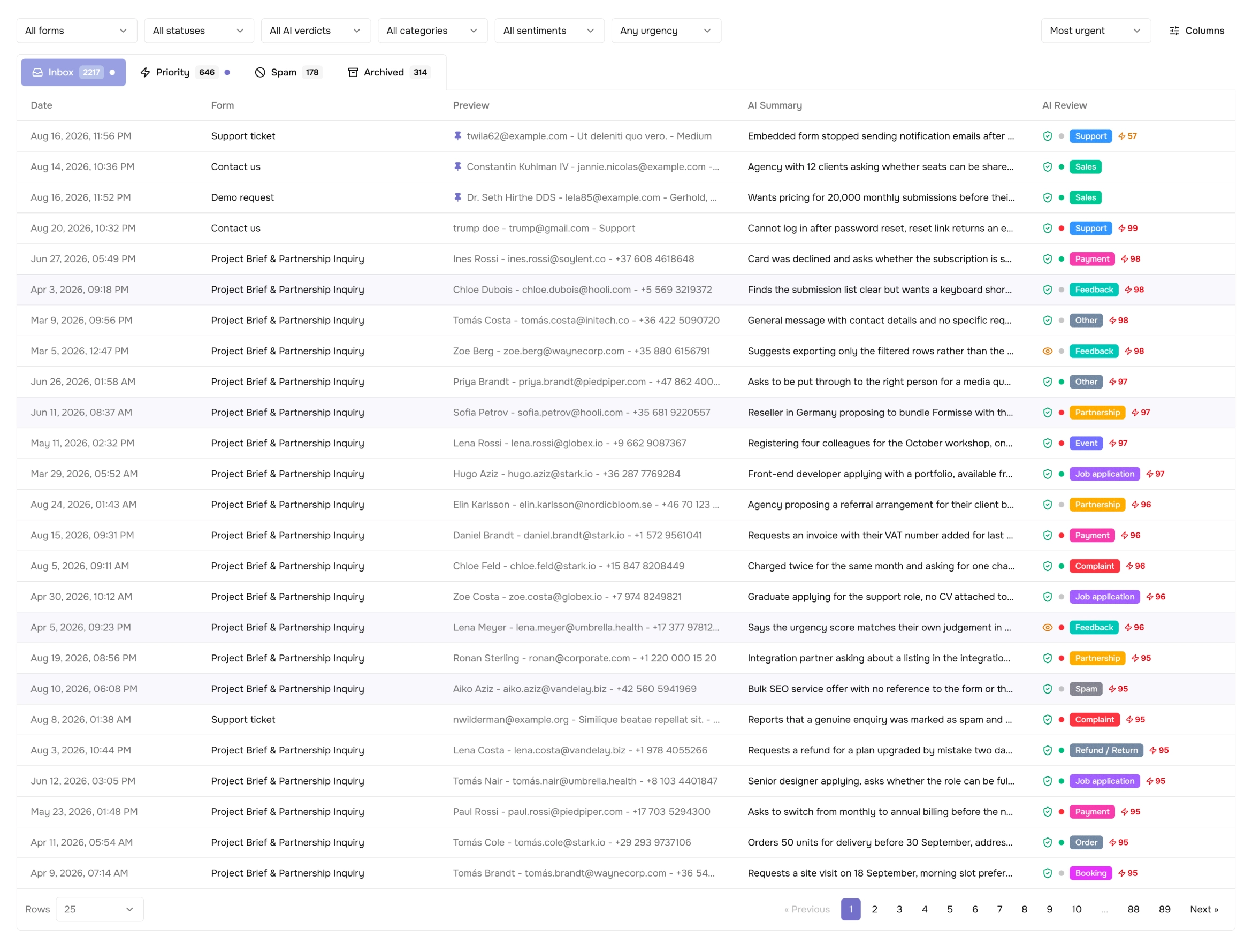
The submission list in Formisse. Every row is its own answer, not a data point in a theme. -
Nothing is billed per response after the fact
SurveyMonkey bills responses beyond your plan allowance at $0.15 each, charged automatically. Formisse's plans have a fixed monthly submission quota, and when you reach it forms stop accepting responses until you upgrade or clear space. You can hit a wall, but you cannot be surprised by a bill.
-
Urgency and spam, built in
Every submission gets an urgency score and a category. Spam goes to a separate, browsable tab rather than being deleted. SurveyMonkey has no equivalent, because a survey platform has no reason to think one respondent is more urgent than another.
-
An inbox with a workflow
Priority tab, spam tab, submission assignment, notes and statuses. Built for the person who has to act on responses, not the person who has to report on them.
-
AI analysis at the entry paid plan
Formisse includes submission analysis on every paid plan, starting at $8 per month billed annually. SurveyMonkey's AI text analysis starts at Advantage Annual, $39 per month billed annually.
Side by side
| Side by side | Formisse | SurveyMonkey |
|---|---|---|
| Unit of analysis | One submission | All responses to a question |
| Output | Summary, category, urgency, next step | Themes, sentiment, statistics |
| When it runs | Automatically, on arrival | When you run the analysis |
| Urgency scoring | Every submission | Not available |
| Spam handling | Separate browsable tab | Not available |
| Over-quota responses | Form pauses; no automatic charge | $0.15 per extra response, auto-billed |
| AI text analysis from | Entry paid plan, $8/mo. (annual) | Advantage Annual, $39/mo. (annual) |
| Research features | None | Cross-tabs, significance testing, panel |
| Best for | Requests and feedback someone must answer | Research, NPS and market surveys |
Competitor details verified from published pricing and plan documentation, September 2026.
Which one should you pick?
Stay with SurveyMonkey if
you are measuring: NPS across a customer base, employee engagement, market research, anything where the aggregate is the point.
Use both if
you run real surveys and have an enquiry form. They are different tools for different forms, and there is no rule saying one vendor has to do both.
Use Formisse if
each response is a person waiting, and the job is to work out who needs answering first.
Questions people ask
Does SurveyMonkey have AI analysis?
Yes. AI text analysis groups open-ended responses into themes with sentiment, available from the Advantage Annual plan ($39 per month billed annually). It analyses a question across all its responses. Formisse analyses each submission individually as it arrives.
Is Formisse a survey tool?
It builds forms and surveys, but it has no research features: no cross-tabs, no significance testing, no respondent panel. If those matter to you, Formisse is the wrong tool.
Can I move my SurveyMonkey surveys to Formisse?
Not automatically. There is no SurveyMonkey importer, and we would rather say so than imply one exists. You rebuild the form in the Formisse builder and then share the Formisse link in place of the SurveyMonkey one. Responses you have already collected stay in SurveyMonkey and can be exported from there, so nothing is lost in the move.
Is Formisse cheaper?
Paid plans start at $8 per month billed annually against $39 per month for SurveyMonkey's entry AI tier, and Formisse does not bill per response over quota. But compare the features you actually need rather than the headline numbers, because these tools do different jobs.
If your survey is really an inbox
Free plan, no credit card. See what it looks like when every response arrives already read and scored.
Start for Free